Device console
Every request, as it arrives
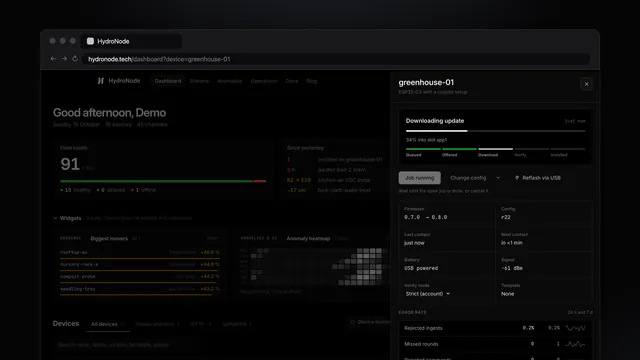
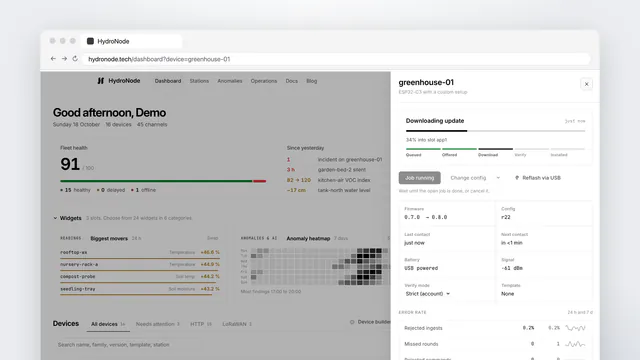
With the reason when one is rejected. Decode LoRaWAN payloads, check link timing and send typed commands from a prompt. The device confirms them, or declines with the reason.
The free IoT platform for ESP32, Arduino and LoRaWAN sensors. Build a device in the browser or bring your own firmware. HydroNode stores every reading, charts it, learns what normal looks like and updates your devices over the air.
// WiFi, time, TLS and HMAC: handled by the library
#include <HydroNode.h>

HydroNode hydro(SENSOR_ID, SECRET_KEY);

void setup() {
  hydro.connectWiFi(WIFI_SSID, WIFI_PASS);
  hydro.begin();
}

void loop() {
  HydroNodeValue v[] = {
    { "TEMPERATURE", readTemp() },
    { "HUMIDITY", readHumidity() },
  };
  hydro.sendValues(v, 2);  // one signed request
  delay(60000);
}
With the reason when one is rejected. Decode LoRaWAN payloads, check link timing and send typed commands from a prompt. The device confirms them, or declines with the reason.
CO₂, PM, VOC and NOx become one score from 0 to 100. A station always shows its worst sensor, never a flattering average.
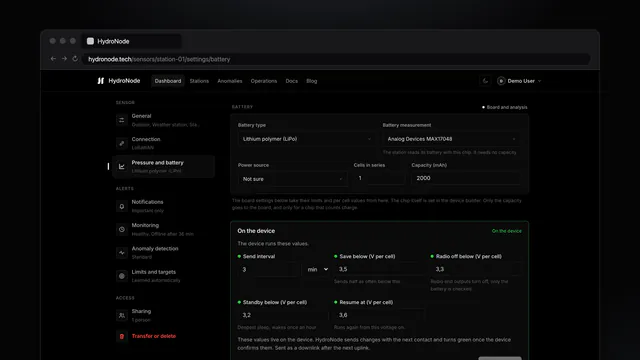
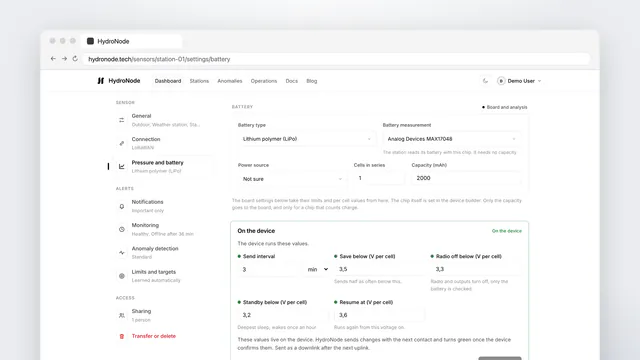
Change wiring, sleep or timing for one board or a whole template. Images are signed, a device that does not come back healthy rolls back on its own.
HydroNode learns how often each sensor reports and judges silence against that rhythm, not a fixed timer. Push or email per stage, and a note when it is back.
Every channel learns its own time aware range. Related findings become one incident instead of ten alerts.
Water pH rose from 6.6 to 8.1 within 40 minutes, above its learned evening range. EC moved with it, which points to dosing rather than a probe fault.
Optional, built only from facts HydroNode has already checked. You can see exactly what goes to the model.
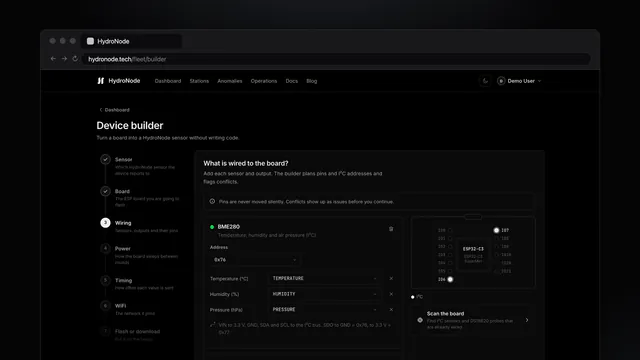
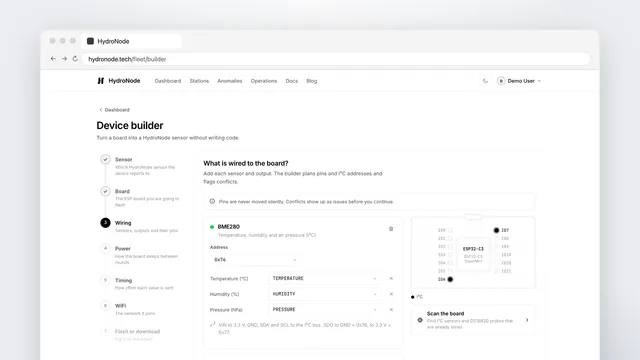
Pick a board and sensors, the builder suggests pins and scans the I²C bus. Flash over USB from Chrome or Edge.
Track pH and EC against your crop targets. Learned channel patterns point out unusual drift long before the plants show it.
Native apps, open firmware and integrations.
Home and lock screen widgets, Live Activities, incident timelines and your own alert level per sensor.
Download on the App Store →The same sensors, widgets, push notifications and device commands, built natively with Jetpack Compose.
Google Play release plannedIn the default HACS catalog. Every sensor becomes a native entity, pushed over WebSocket in real time.
View on GitHub →ESP32 and ESP8266: WiFi, millisecond time, TLS, HMAC signing and typed commands the device confirms or declines.
View on GitHub →Map any ESPHome sensor to HydroNode in YAML, with remote commands driving your existing automations.
View on GitHub →Solar powered outdoor station: SCD41, SPS30, SHT45, BMP390, LTR390. No mains, no WiFi, no SIM. STM32WL.
View on GitHub →Yes. Every account can create up to 20 sensors with every feature included. There is no subscription, no card and no activation code.
Anything that can send a signed HTTPS request or a LoRaWAN uplink. The Device Builder flashes ESP32, ESP32 S2, S3, C3, C6 and ESP8266 boards without code. Custom firmware uses the Arduino library or the ESPHome component, and LoRaWAN devices connect through The Things Network, ChirpStack or Helium.
No. In the Device Builder you pick a board, sensors, pins and a power mode, then flash it from Chrome or Edge over USB. Later changes reach the device over the air. If you prefer code, you can download the same setup as a PlatformIO project, an Arduino sketch or ESPHome YAML.
Firmware images are signed with ECDSA P-256 and checked on the device before they run. A device that does not come back healthy rolls back to its previous firmware on its own. Config updates work on every board, firmware updates on the ESP32 family.
HydroNode learns how often each sensor reports. It marks a sensor delayed after three missed intervals and offline after twelve, and tells you by push or email if you want it to.
Yes. Install HydroNode from the default HACS catalog. Every sensor becomes a native entity that updates in real time over WebSocket, ready for your automations.
Only you, until you decide otherwise. You can share a sensor at read, write or admin level, or publish an outdoor station on the public map. Devices sign every request with HMAC SHA256.